Meeting Other Travelers in Bali Without Dating Apps
Bali is often described as an easy place to meet people.
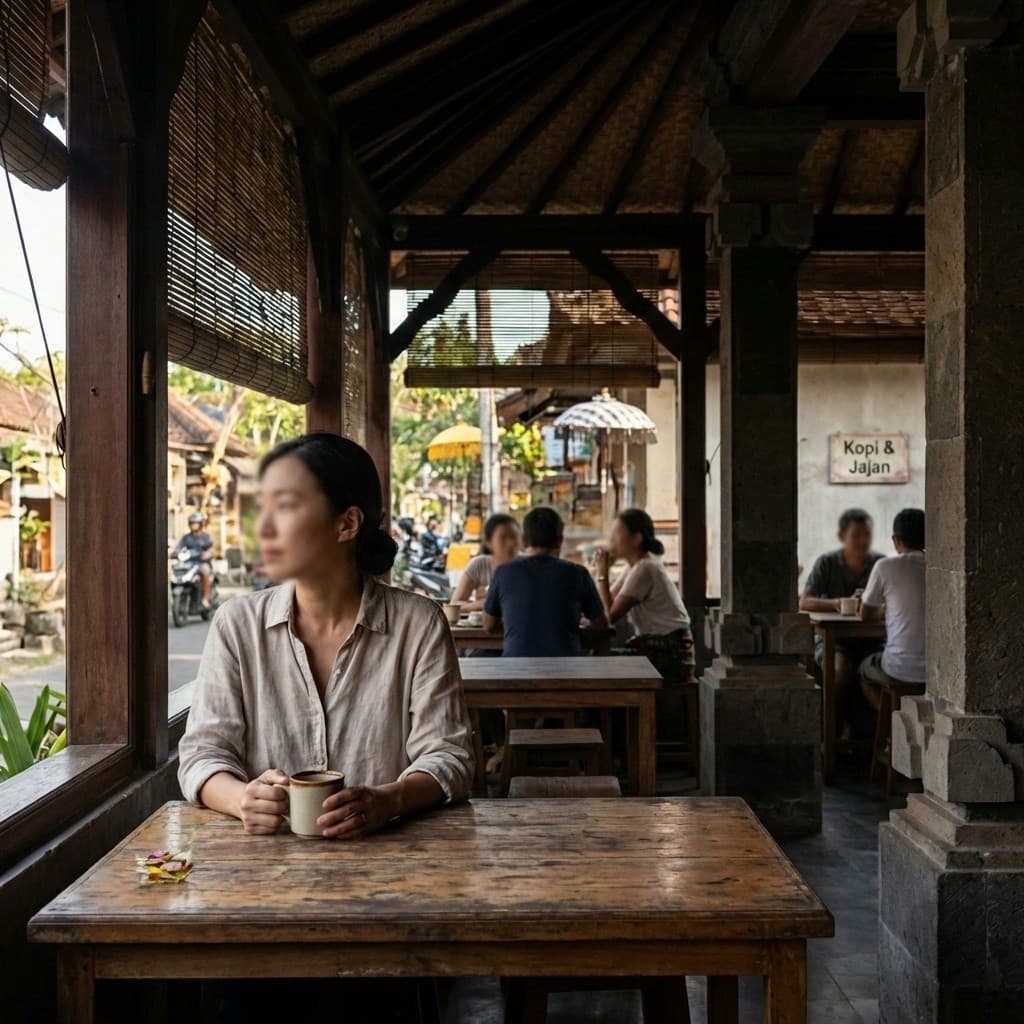
Cafés are open, conversations start casually, and travelers from everywhere seem to pass through the same neighborhoods. On the surface, connection appears abundant.
And yet, many solo travelers leave Bali with a quiet, unresolved feeling — that despite all the interaction, something was missing.
The paradox of Bali is that it is socially dense but emotionally fragmented.
You meet people easily here. You rarely stay connected.
Part of this comes from Bali’s unique travel rhythm. Unlike cities where people arrive briefly and leave, Bali attracts travelers who stay for weeks or months — yet rarely at the same pace.
People arrive mid-journey. Some are recovering from burnout. Some are between chapters. Others are “just staying a little longer.”
The result is a constantly shifting social landscape.
You might recognize the same faces at breakfast cafés for a week. Conversations feel warm. Familiarity builds quietly. And then, one day, those faces disappear.
No goodbyes. No transitions. Just absence.
This creates a subtle instability in how connection forms.
Conversations tend to stay light. People hesitate to invest. There is an unspoken understanding that most interactions are temporary — even if no one says it aloud.
Dating apps enter this environment with the wrong assumptions.
They compress human interaction into intent. They ask people to decide what something is before it has had a chance to be anything.
In Bali, that acceleration feels particularly misaligned.
Many travelers here are intentionally slowing down. They are relearning how to inhabit their days without urgency. Introducing swipe-based dynamics often pulls them out of that rhythm.
Even when profiles say “not looking to date,” the structure itself introduces expectation. Conversations feel weighted before they’ve begun.
On the other end of the spectrum, social spaces in Bali tend to optimize for novelty.
Hostels, events, and pop-up gatherings are designed to bring people together quickly — but not necessarily repeatedly.
You meet many people once. You rarely meet the same people again under conditions that allow something to deepen.
For travelers who value independence, this creates a difficult choice: remain open but unanchored, or withdraw entirely.
What often goes unspoken is that many people in Bali are not looking for more interaction. They are looking for continuity.
Shared routines. Familiar faces. Conversations that don’t reset every few days.
These forms of connection don’t announce themselves loudly. They emerge quietly, through repetition and presence.
But few systems are designed to support that middle ground.
Bali exposes this gap more clearly than most places.
It shows how easily interaction can be mistaken for connection — and how often travelers feel the difference without having the language to describe it.
Wanting companionship here does not mean wanting romance. Wanting conversation does not mean wanting obligation.
It means wanting to share moments without turning them into something heavier than they need to be.
This is the space Besidey is designed for.
Not to replace independence, but to support it. Not to accelerate connection, but to allow it to form naturally — with people who are present in the same place, at the same time.
If Bali has ever felt socially rich but emotionally unresolved, there is nothing wrong with how you traveled.
You were simply noticing the difference between being around people and being connected to them.